
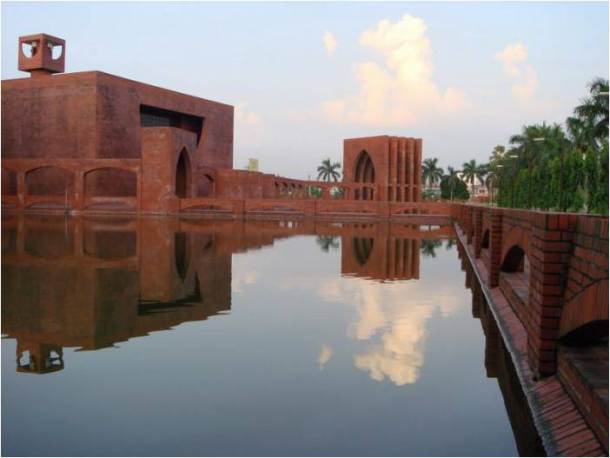
A Contemporary Mosque
Mosques are an integral part of any Muslim neighborhood or community. Its primary function is to provide a place for prayer which is compulsory for all Muslims who have reached adulthood. Islam does not prescribe to any architectural model or material except that the front of the mosque face Mecca, in Saudi Arabia.
Function:
A mosque is a gathering place for five prescribed prayers a day. The prayers are short and recited in Arabic. The prayer format has not changed over the past 1,400 years, so a Muslim from Moscow can pray in South Africa and won’t feel out-of-place. However, the Friday sermon can be given in any language. Since, Islam has no church and priesthood, in most of the mosques Imam leading the prayer is hired or fired by the committee who runs the affairs of the mosque. An Imam leading the prayer does not necessarily play a leading role in the religious or communal affairs of the community. He is not a priest who is responsible for his flock, or a Rabbi leading the congregation. Often people don’t even know the name of their Imam.
Islam is a communal faith; all of its required rituals are performed in congregation. Given this emphasis on communal unity mosques do bring people together in a neighborhood, if people do not know each other by name they do recognize each other by face. Mosques are not a place of sanctuary like churches, so it is rare that anyone would seek sanctuary there from authorities. In most Muslim countries mosques are open from early morning to late night, or sometimes they are open 24/7.
Form:
The mosques are mostly built by private donations and run by neighborhood committees. Their structure, size, and comfort levels reflect the status of the community. Therefore in poor communities one will find a shack with tin roof and in rich parts of the city an air-conditioned mosque. Mosques cannot be adorned with statuary or paintings and there is no furniture except a simple ground covering. Every mosque has a row of water taps for compulsory washing of face, hands, and feet before the prayer. Shoes are not allowed in the mosque-proper because people sit and perform prayers on the floor covered by a rush mat or a carpet.
The earliest mosque in Islam is in Mecca, Saudi Arabia but its form and function is unique to it. The mosque which became the model for all the mosques in the world is Prophet’s Mosque in Medina, also in Saudi Arabia. That mosque was a modest rectangular structure, made of mud walls with date palm trunks serving as roof beams. The roof was made of palm fronds covered by mud. The mosque also had a small open yard. There was no attempt to adorn it with verses from Quran or make it monumental in any sense of the word. Every mosque built since then essentially has the same lay out. As far as architectural style goes Muslims adopted the materials and styles of construction prevalent where they lived. The two most distinct features of a mosque dome and minarets (towers) were borrowed from Byzantine.
Mecca: The most important mosque in Islam:
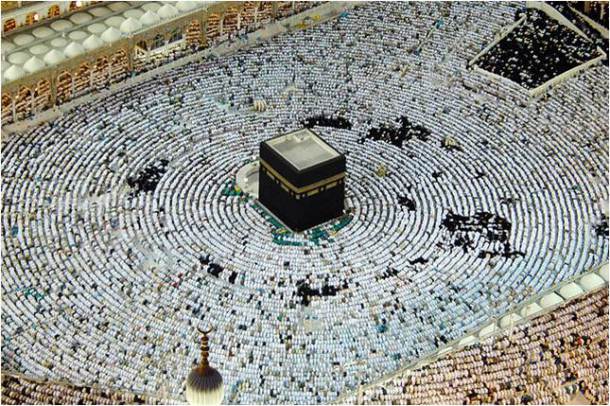
The first Mosque in Islam, Mecca Saudi Arabia
The cube in the center is a stone structure; it has been rebuilt many times but has retained the original foot print. It is about 43 foot by 38 foot in size and approximately 30 feet high. Inside, there are three pillars supporting the roof, otherwise it is empty. It is covered in a black embroidered cloth called Qiswa. The tradition of covering this structure with a black cloth dates back to pre-Islamic times. The covering is replaced every year at the time of Hajj, the yearly pilgrimage by Muslims. Over the past 50 years this mosque has been expanded repeatedly, now it covers approximately 88 acres and can accommodate close to a million people.
Mosque of the Prophet in Medina:
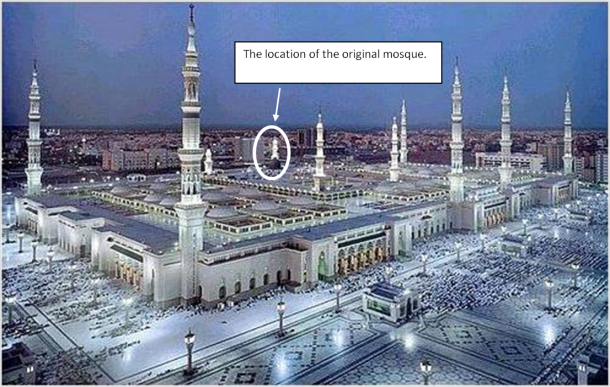
Prophet’s Mosque, Medina Saudi Arabia
Prophet’s Mosque was built in 622 CE, in the city of Medina. This expanded version of the mosque now accommodates a million worshippers and pretty much covers the land area of the town of Medina during Prophet’s time. This is the second most important mosque in Islam and one of the most frequented sites for pilgrims. Prophet Muhammad lived in a room next to this mosque and he was buried in the same room in 632 CE. The green dome built by Turks in 15th century marks the Prophet Muhammad’s grave. The mosque has been rebuilt and expanded over the centuries but in recent years the expansion has surpassed all previous expansions.
The mosques in Mecca and Medina are sacred to Muslims but in terms of architectural style are not significant. While the grand mosques built by Muslim emperors in Damascus, Delhi, and Istanbul were architecturally superior but had no religious significance. These mosques built by rulers were not the seat of religious authority like Catholic Cathedrals where Cardinals sat. These mosques were in some respect vanity projects carried out to affirm the bona-fides of the monarch as a Muslim ruler. After the demise of Kings and Sultans now these mosques have become architectural relics and tourist destinations.
In the following post I would highlight some of the regional styles of architecture and few well-known mosques in Damascus, Isfahan, Delhi and Istanbul.
 A Perspective on Neighborhood Change: Crown Heights
 The Divide Between Architecture and Landscape Architecture: Part I
 Mosque: Form and Function
 Guide to Vienna: Part 1 - Why I Love Vienna
 60 Mies van der Rohe Haus
 Planning Love: V-Day Cards
 Love Letters
 Becoming the Cycling Capital of the 21st Century
 Mortgage Complaints
 Transporting Transportation


Nicely written description of the mosques and their evolution. Due to rapid the expansion of the area surrounding Kaba, Saudis advising to skip hajj this year, something that confirms your observations about the holy sites. excellent resource for non muslims to understand the basics of islam. you are engaged in a noble cause, JK
syed asad
Thanks.
Very well written and good presentation of Mosque-Form-and-Function. I would like see and read your next article on the same subject.
Thanks.